

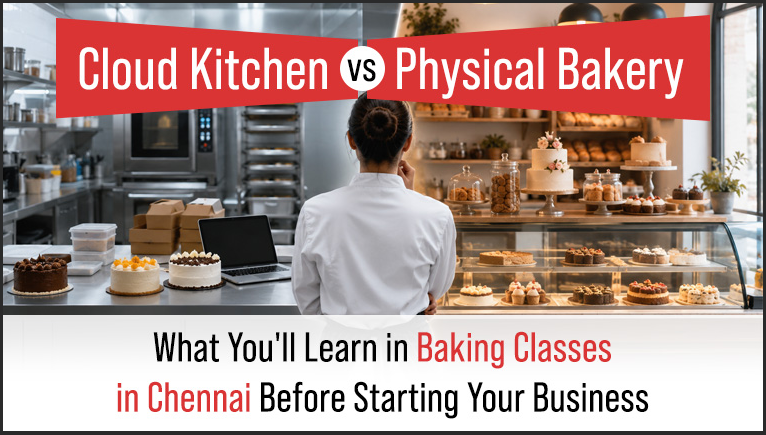
There’s a particular kind of overwhelm that hits most aspiring bakers around their third business plan draft, staring at two very different roads ahead, a cloud kitchen with lower overhead and a quicker setup, or a physical bakery with a storefront, walk-in customers, and a much heavier financial commitment. Neither option feels obviously wrong. That’s what makes it so hard to decide. This is exactly the kind of decision structured bakery classes In Chennai are increasingly built to prepare people for, not by pushing one model over the other, but by giving future bakers enough real understanding of both to choose with clarity instead of a coin toss.
So which one’s actually better, a cloud kitchen or a physical bakery? Wrong question, honestly. They’re two completely different businesses that just happen to start with the same flour and sugar. This piece breaks down the real gap in what each costs to start and how much risk you’re actually taking on, because it’s not close. It also gets into how customer relationships form so differently between the two, delivery orders feel nothing like walk-in regulars who know your name.
Then there’s the day-to-day stuff nobody warns you about, the operational chaos of running delivery-only versus dealing with retail foot traffic, and how the skills you need on your team shift depending on which model you’re running. Bottom line: the “right” choice has way more to do with what you personally want out of this than whatever’s trending on Instagram right now. And no matter which path you pick, proper training still matters just as much. This isn’t about picking a winner. It’s about actually understanding that these are two different games, even if they look similar on the surface.
Why Does This Decision Feel So Overwhelming?
Because it isn’t really one decision, it’s dozens of smaller ones dressed up as a single choice. Location, staffing, equipment, marketing, even personal lifestyle preferences, all of it shifts depending on which model gets picked. Most aspiring bakers go into this looking for the objectively “better” option, when the more useful question is really which model fits their specific resources, risk appetite, and long-term vision. Just reframing the question that way tends to make the whole decision feel a lot less paralysing.
How Different Is the Actual Startup Cost?
Quite a bit, and this is usually the first thing that pulls people toward cloud kitchens. A physical bakery needs rent, interior fit-out, seating if there’s a sit-down component, signage, and a location that actually draws footfall, costs that pile up before a single cake gets sold. A cloud kitchen skips most of that, running out of a smaller commercial space focused purely on production and delivery logistics. Lower upfront cost sounds great, and often is, but it comes with a tradeoff that’s worth understanding clearly before assuming it’s automatically the easier route.
Do Customer Relationships Form Differently in Each Model?
Yes, and more than people usually expect. A physical bakery builds relationships through repeat visits, familiar faces, small conversations at the counter, the kind of loyalty that grows slowly but tends to run deep once it does. A cloud kitchen builds relationships almost entirely through digital touchpoints, reviews, delivery experience, whether the photos match what actually shows up at the door. Neither approach is worse, but they demand different skills. A cloud kitchen owner basically needs to think like a brand manager online. A physical bakery owner needs a strong, warm presence in person.
What Are the Operational Realities Nobody Talks About Enough?
Cloud kitchens sound simpler right up until the delivery logistics show their true colours. Packaging that can actually survive transit without wrecking a delicate bake, third-party delivery platforms chewing into margins with their commissions, and trying to keep quality consistent without a storefront where you can watch it happen, these all create their own set of headaches. Physical bakeries deal with a different set of problems, walk-in demand that swings unpredictably, more staff needed just for the front-of-house side, and the constant pressure of a fixed location that needs steady footfall no matter the season. Both models are genuinely hard work. Just hard in different directions.
Does Staffing and Skill Requirement Really Change Based on Model?
Quite a lot, actually. A cloud kitchen leans heavily on production efficiency and consistency at volume, since most orders go out without a customer ever setting foot in the kitchen. A physical bakery needs a whole other set of skills that have nothing to do with baking itself, customer service, in-person merchandising, managing a retail space that people physically walk through. This is exactly where structured training earns its keep, whichever path someone eventually picks. At Zeroin Academy, practical sessions increasingly cover both models directly, helping students get comfortable with the production-focused workflows a cloud kitchen needs alongside the customer-facing skills a physical bakery demands, so the choice never gets made blind to what each path actually asks for day to day.
Is One Model Objectively Better Than the Other?
No, and anyone insisting otherwise is probably selling something. Cloud kitchens suit people who want lower risk, flexible scaling, and are comfortable engaging with customers mostly online. Physical bakeries suit people who value face-to-face connection, can handle a bigger upfront investment, and want a real, tangible presence in their community. Success stories exist on both sides, and so do failures, usually tied less to the model itself and more to whether the owner actually understood what that model demanded before jumping in.
How Should Someone Actually Decide Between the Two?
By being honest about their own strengths and limits, rather than chasing whichever model sounds more exciting at the moment. Someone with limited capital but strong instincts for social media might find a cloud kitchen fits them naturally. Someone who genuinely thrives on face-to-face interaction and has the funds to back it might find a physical bakery far more fulfilling, even with the higher risk upfront. There’s no single right answer here, just an honest one, shaped by circumstances that look different for everyone.
That moment of staring at two paths, cloud kitchen or physical bakery, unsure which one deserves years of effort and savings, rarely gets resolved by piling on more research. It gets resolved through real self-awareness paired with a genuine understanding of what each model actually demands. For those in Chennai still working through this decision, exploring baking classes offers a chance to see both realities up close before a single rupee gets committed to either one. Neither path guarantees success. But understanding both clearly, before choosing, is what turns a guess into a decision someone can actually stand behind.
There’s a particular kind of overwhelm that hits most aspiring bakers around their third business plan draft, staring at two very different roads ahead, a cloud kitchen with lower overhead and a quicker setup, or a physical bakery with a storefront, walk-in customers, and a much heavier financial commitment. Neither option feels obviously wrong. That’s what makes it so hard to decide. This is exactly the kind of decision structured bakery classes are increasingly built to prepare people for, not by pushing one model over the other, but by giving future bakers enough real understanding of both to choose with clarity instead of a coin toss.
This piece looks at how a cloud kitchen model stacks up against a physical bakery, and what someone actually needs to understand about each before pouring years of effort and savings into either one. It covers the real gap in startup cost and risk, how customer relationships form so differently in each setup, the operational headaches of delivery-only businesses versus walk-in retail, how staffing and skill needs shift depending on the model, and why the “right” choice comes down to personal goals far more than whichever model happens to be trending. It also touches on why structured training still matters no matter which path someone eventually takes. None of this is about crowning a winner. It’s about understanding two genuinely different businesses that just happen to share the same starting ingredient list.
Why Does This Decision Feel So Overwhelming?
Because it isn’t really one decision, it’s dozens of smaller ones dressed up as a single choice. Location, staffing, equipment, marketing, even personal lifestyle preferences, all of it shifts depending on which model gets picked. Most aspiring bakers go into this looking for the objectively “better” option, when the more useful question is really which model fits their specific resources, risk appetite, and long-term vision. Just reframing the question that way tends to make the whole decision feel a lot less paralysing.
How Different Is the Actual Startup Cost?
Quite a bit, and this is usually the first thing that pulls people toward cloud kitchens. A physical bakery needs rent, interior fit-out, seating if there’s a sit-down component, signage, and a location that actually draws footfall, costs that pile up before a single cake gets sold. A cloud kitchen skips most of that, running out of a smaller commercial space focused purely on production and delivery logistics. Lower upfront cost sounds great, and often is, but it comes with a tradeoff that’s worth understanding clearly before assuming it’s automatically the easier route.
Do Customer Relationships Form Differently in Each Model?
Yes, and more than people usually expect. A physical bakery builds relationships through repeat visits, familiar faces, small conversations at the counter, the kind of loyalty that grows slowly but tends to run deep once it does. A cloud kitchen builds relationships almost entirely through digital touchpoints, reviews, delivery experience, whether the photos match what actually shows up at the door. Neither approach is worse, but they demand different skills. A cloud kitchen owner basically needs to think like a brand manager online. A physical bakery owner needs a strong, warm presence in person.
What Are the Operational Realities Nobody Talks About Enough?
Cloud kitchens sound simpler right up until the delivery logistics show their true colours. Packaging that can actually survive transit without wrecking a delicate bake, third-party delivery platforms chewing into margins with their commissions, and trying to keep quality consistent without a storefront where you can watch it happen, these all create their own set of headaches. Physical bakeries deal with a different set of problems, walk-in demand that swings unpredictably, more staff needed just for the front-of-house side, and the constant pressure of a fixed location that needs steady footfall no matter the season. Both models are genuinely hard work. Just hard in different directions.
Does Staffing and Skill Requirement Really Change Based on Model?
Quite a lot, actually. A cloud kitchen leans heavily on production efficiency and consistency at volume, since most orders go out without a customer ever setting foot in the kitchen. A physical bakery needs a whole other set of skills that have nothing to do with baking itself, customer service, in-person merchandising, managing a retail space that people physically walk through. This is exactly where structured training earns its keep, whichever path someone eventually picks. At Zeroin Academy, practical sessions increasingly cover both models directly, helping students get comfortable with the production-focused workflows a cloud kitchen needs alongside the customer-facing skills a physical bakery demands, so the choice never gets made blind to what each path actually asks for day to day.
Is One Model Objectively Better Than the Other?
No, and anyone insisting otherwise is probably selling something. Cloud kitchens suit people who want lower risk, flexible scaling, and are comfortable engaging with customers mostly online. Physical bakeries suit people who value face-to-face connection, can handle a bigger upfront investment, and want a real, tangible presence in their community. Success stories exist on both sides, and so do failures, usually tied less to the model itself and more to whether the owner actually understood what that model demanded before jumping in.
How Should Someone Actually Decide Between the Two?
By being honest about their own strengths and limits, rather than chasing whichever model sounds more exciting at the moment. Someone with limited capital but strong instincts for social media might find a cloud kitchen fits them naturally. Someone who genuinely thrives on face-to-face interaction and has the funds to back it might find a physical bakery far more fulfilling, even with the higher risk upfront. There’s no single right answer here, just an honest one, shaped by circumstances that look different for everyone.
That moment of staring at two paths, cloud kitchen or physical bakery, unsure which one deserves years of effort and savings, rarely gets resolved by piling on more research. It gets resolved through real self-awareness paired with a genuine understanding of what each model actually demands. For those in Chennai still working through this decision, exploring baking classes in Chennai Velachery offers a chance to see both realities up close before a single rupee gets committed to either one. Neither path guarantees success. But understanding both clearly, before choosing, is what turns a guess into a decision someone can actually stand behind.